Best Direct Drive Wheelbases for Sim Racing
By PitLaneLab · 10 min read · Updated November 2026
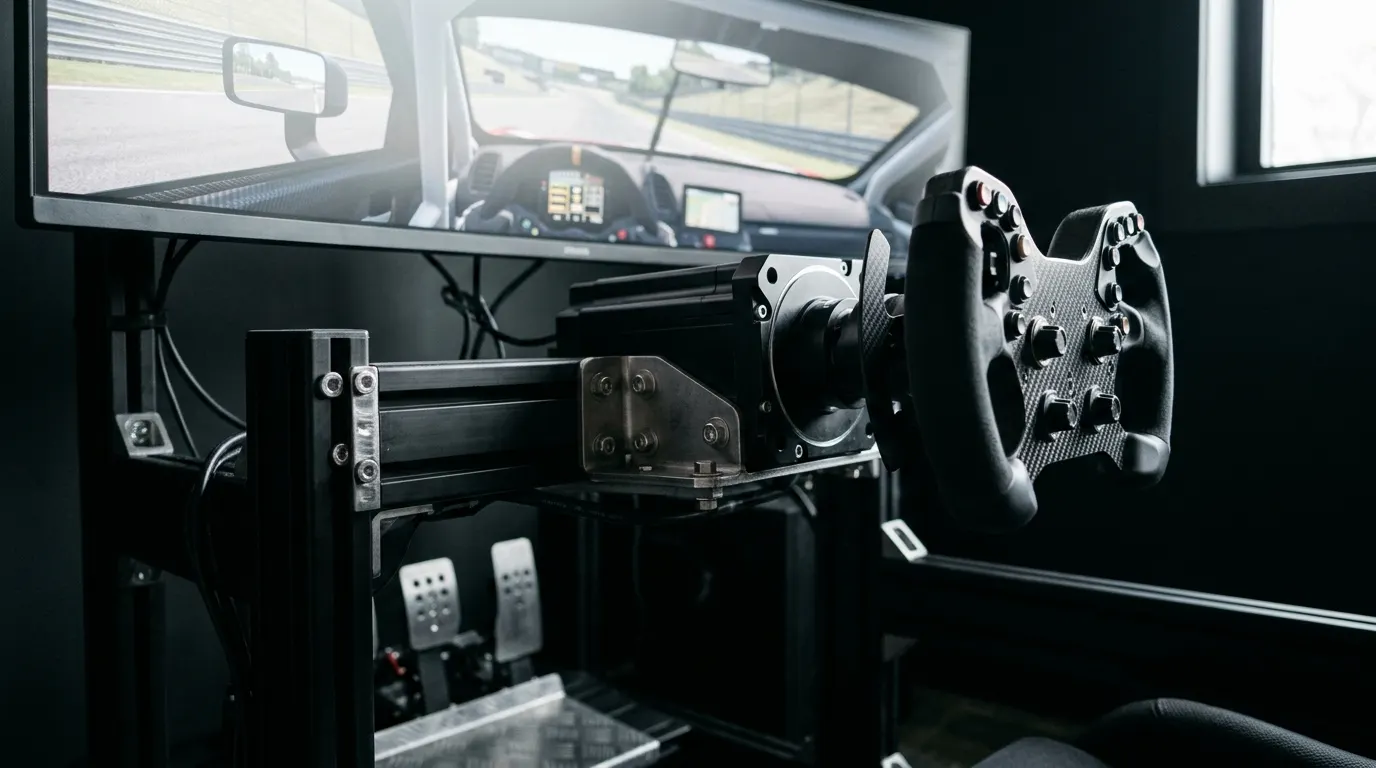
A direct drive wheelbase bolts the steering shaft straight to the motor, so nothing sits between the force feedback signal and your hands. The hard part is no longer deciding whether direct drive is good, it is choosing a base without overspending on torque you will never run or locking yourself into the wrong rim system. The Moza R9 is where most buyers should start, the Moza R3 is the low-cost way in, and the Simucube 2 Sport is the step up for drivers who race competitively. This guide covers seven bases. The Moza R9 comes first as the best fit for most buyers, and the other six follow in rising catalog price, so a higher number means a higher price, not a better wheelbase. Torque figures are the ratings each maker publishes.
Quick answer
The Moza R9 is the best direct drive wheelbase for most sim racers, listed at 9 Nm. The Moza R3 is the cheapest pick in this guide, the Fanatec CSL DD suits buyers who want QR2 rims or Xbox support, and the Simucube 2 Sport is the pick for competitive iRacing and ACC drivers who want more headroom.
This guide contains affiliate links. PitLaneLab may earn a commission at no cost to you.
Which direct drive wheelbase should most sim racers buy?
The Moza R9 is the direct drive wheelbase most sim racers should buy, because its 9 Nm covers GT, formula, and rally driving without forcing an expensive rig upgrade on day one.
The other picks in this guide exist for specific situations. Go lower with the Moza R3 if budget or desk mounting is the deciding factor. Choose the Fanatec CSL DD if you want QR2 rims or need an Xbox path. Move up to the Simucube 2 Sport or Simucube 2 Pro only if you race competitively and your rig is already rigid enough to use the extra force.
How much torque do you actually need?
The Moza R9, the Fanatec CSL DD with the Boost Kit 180, and the Simagic Alpha Mini are rated at 8 to 10 Nm, and that band is enough for most home sim racers according to the PitLaneLab rule of thumb we use when recommending gear.
Peak torque is a ceiling, not a quality score. Most drivers do not run a strong base at full strength for hours at a time, and the useful part of extra torque is headroom: the sim can send a large peak without the base running out of force and flattening the detail around it, which is called clipping. A higher-rated base gives you more of that headroom, but it also asks more of your rig and your arms.
A sensible way to choose is to start from how you race. Casual sessions and shorter races work well at the lower end. Long GT stints and regular league racing are the point where the middle of this list starts to pay off. The top of the list is for drivers who specifically want heavy, realistic steering forces and have the mounting to support them.
1. Moza R9
The Moza R9 is the best all-round pick in this guide, pairing 9 Nm of torque at $280 to $330 with the Pit House tuning software and a quick-release that makes rim swaps tool-free.
The Moza R9 earns the top spot because it asks for the fewest compromises. It has enough force to feel convincing in every major discipline, it does not demand a heavy aluminium cockpit to work well, and the Moza range of rims and pedals gives you a clear upgrade path. The main trade-off is that you are buying into the Moza rim system, so a collection of rims from another brand will need adapters or replacing.

Moza R9 Direct Drive Wheel Base
9 Nm of direct drive torque with Moza's quick-release, a full SimHub-compatible software suite, and the best price-to-performance ratio in its class.
2. Moza R3
The Moza R3 is the cheapest entry in this guide at $219 to $259, and at 3.9 Nm it is modest torque but still true direct drive with no belt or gears between motor and wheel.
The Moza R3 suits new sim racers and anyone stepping off a belt-drive wheel who wants to find out what direct drive is like without a large outlay. It is compact enough for a desk or an entry cockpit and it shares the wider Moza accessory range. The limit is force: drivers who want heavy steering or plan to run a long league season may outgrow it, so if you already know this is a long-term hobby, the R9 is often the better first purchase.

Moza R3 Direct Drive Wheel Base
Entry-level direct drive at under $250 with 3.9 Nm of clean torque and the full Moza ecosystem.
3. Fanatec CSL DD
The Fanatec CSL DD is the pick for buyers who want a very wide rim choice, rated at 5 Nm, or 8 Nm with the Boost Kit 180, and priced at $349 to $449.
The Fanatec CSL DD is the base to look at if the QR2 rim range appeals to you or if you need a route onto Xbox, which works only with a Fanatec Xbox-licensed wheel, because Fanatec says the CSL DD is not compatible with any PlayStation console. Xbox use also means buying that wheel, so price it in. Read the listing carefully, because the torque you get depends on whether the Boost Kit is included.
4. Simagic Alpha Mini
The Simagic Alpha Mini is the compact mid-tier alternative at $499 to $579, with 10 Nm, a touch more than the Moza R9, in a small housing that suits tighter cockpits.
The Simagic Alpha Mini makes sense for PC racers who like the Simagic hardware range and want a tidy base with a bit more force than the R9. The trade-off is ecosystem size: the Simagic rim range is smaller than the Fanatec or Moza lineups, so check that the rim you want is available before you commit.

Simagic Alpha Mini Direct Drive Wheel Base
10 Nm of direct drive torque with Simagic's GTS connector, a compact build, and strong iRacing and ACC support from a rapidly growing brand.
5. Fanatec ClubSport DD+
The Fanatec ClubSport DD+ is the step up for Fanatec owners who want more torque, at 18 Nm and $899.99, with the same QR2 rim system as the CSL DD.
The Fanatec ClubSport DD+ is most compelling if you already own QR2 rims, because you keep them and, with most rims, gain a large jump in available force. Fanatec says a few QR2 wheels, including the CSL Elite Steering Wheel WRC, CSL Steering Wheel P1 V2, CSL Steering Wheel BMW and the Steering Wheel for Gran Turismo DD Pro, stay limited to 8 Nm. It suits dedicated PC and PlayStation racers, since Fanatec lists PS5 and PS4 support, and it gives strong force feedback without going full Simucube. At this level, budget for a rigid cockpit as part of the purchase.
6. Simucube 2 Sport
The Simucube 2 Sport is the pick for competitive iRacing and ACC drivers, with 17 Nm at $999 to $1,099 and tuning software that gives deep control over how force feedback is filtered.
The Simucube 2 Sport is for racers who care about force feedback detail above price. It costs more than every base listed before it here, and its SQR rim ecosystem is smaller than Fanatec QR2. It also needs a rigid frame to show what it can do, so treat the base and the cockpit as one decision rather than two.

Simucube 2 Sport Direct Drive Wheel Base
17 Nm of Finnish-engineered direct drive precision with the SQR quick-release, the entry point into Simucube's world-class force feedback.
7. Simucube 2 Pro
The Simucube 2 Pro is the top of this guide for torque and price, at 25 Nm and $1,350 to $1,400, and it only makes sense on a rigid rig and for drivers who will actually use that headroom.
The Simucube 2 Pro is specialist hardware for dedicated competitors and simulator training setups. Few home drivers will run anything close to its peak force for long, so most buyers considering it should first ask whether the Sport already covers what they need. If you do want it, a rigid aluminium profile cockpit is part of the cost of ownership, not an optional extra.

Simucube 2 Pro Direct Drive Wheel Base
25 Nm of servo-grade direct drive torque, the strongest signal in the Simucube lineup and the choice of professional esports programs.
Which quick-release ecosystem should you commit to?
Fanatec QR2, Simucube SQR, and the separate Moza and Simagic quick-releases are different standards, so the base you choose largely decides which rims fit without an adapter.
If you own no rims yet, this choice is easy to get wrong by focusing only on torque. Look at the rims you actually want to drive with, and work backward to the base. The Fanatec CSL DD leads into the widest QR2 rim selection, the Moza R9 leads into the Moza range but takes Moza QR rims only without a third-party adapter, and the Simucube 2 Sport has the smaller SQR ecosystem. If you already own a valuable rim, price a good adapter or a replacement before you treat a cheaper base from another brand as a saving.
What rig or desk does a direct drive wheelbase need?
Trak Racer and Sim-Lab rigs are the safe home for any base above about 10 Nm, which is a PitLaneLab rule of thumb rather than a manufacturer rating, while lighter bases can start on a solid desk or steel frame.
The Trak Racer TR8 Pro is a 2-inch steel tube cockpit that Trak Racer rates for up to 30 Nm of direct drive torque, and the Sim-Lab P1X is an aluminium profile cockpit; both suit the upper half of this list. A folding frame like the Next Level Racing GT Lite is attractive for small rooms, but it flexes more than a heavy tube or aluminium profile rig at high torque, so keep expectations modest with the stronger bases.
Respect the hardware at any torque level. These motors can spin a rim hard and without warning, so follow the safety instructions in the manual for your base, raise strength gradually in the software, and keep your thumbs outside the spokes rather than hooked behind them.

Trak Racer TR8 Pro Cockpit Rig
Heavy 2-inch steel tube rig that Trak Racer rates for direct drive torque up to 30 Nm, with full adjustment for seat position, pedal angle, and wheel height.
Sim-Lab P1X Cockpit Rig
Heavy aluminium profile cockpit with an adjustable pedal plate angle, wide side pod mounts, and direct compatibility with Sim-Lab's own pedal and button box range.
Is direct drive worth it over a Logitech or Thrustmaster wheel?
The Logitech G923 and Thrustmaster T300RS are the fair comparison point. The G923 is gear-driven and the T300RS is belt-driven, so a gear or belt stage sits between motor and shaft that a direct drive motor does not have.
That gear or belt stage is why a direct drive base tends to feel sharper over kerbs and more communicative as the front tyres start to slide. It is a real improvement, but not a mandatory one. If you mainly race on console, or you drive casually a few times a month, the Logitech G923 and Thrustmaster T300RS GT still make sense, partly because they come ready to race. Move to direct drive once you know the hobby is sticking and your current wheel is what you notice most.
What should you check before you buy?
Check what is in the box before you compare prices, because a base is not a complete racing setup and the listing may not include a rim or pedals.
Add up the full cost first: base, rim, pedals, and any cockpit you need. Then confirm platform support on the maker compatibility page, since PC support does not imply console support. Check the exact model and revision on the listing as well, because the same product name can cover different bundles and, as with the Fanatec CSL DD and its Boost Kit, different torque outputs. Prices on this hardware move often, so compare the current listing rather than an old forum recommendation.
Featured in this guide
Moza R9 Direct Drive Wheel Base
9 Nm of direct drive torque with Moza's quick-release, a full SimHub-compatible software suite, and the best price-to-performance ratio in its class.
Moza R3 Direct Drive Wheel Base
Entry-level direct drive at under $250 with 3.9 Nm of clean torque and the full Moza ecosystem.
Simagic Alpha Mini Direct Drive Wheel Base
10 Nm of direct drive torque with Simagic's GTS connector, a compact build, and strong iRacing and ACC support from a rapidly growing brand.
Simucube 2 Sport Direct Drive Wheel Base
17 Nm of Finnish-engineered direct drive precision with the SQR quick-release, the entry point into Simucube's world-class force feedback.
Simucube 2 Pro Direct Drive Wheel Base
25 Nm of servo-grade direct drive torque, the strongest signal in the Simucube lineup and the choice of professional esports programs.
Trak Racer TR8 Pro Cockpit Rig
Heavy 2-inch steel tube rig that Trak Racer rates for direct drive torque up to 30 Nm, with full adjustment for seat position, pedal angle, and wheel height.
Sim-Lab P1X Cockpit Rig
Heavy aluminium profile cockpit with an adjustable pedal plate angle, wide side pod mounts, and direct compatibility with Sim-Lab's own pedal and button box range.
Keep reading
Related comparisons
Related roundups
FAQ
Frequently asked questions
What is the best direct drive wheelbase for most people?+
The Moza R9 is the best fit for most sim racers. At 9 Nm it has plenty of force for GT, formula, and rally driving on a home rig, and the Pit House software is easy to work with. Buy more torque only if you already know you want it.
Is a 3.9 Nm direct drive base strong enough?+
Yes, for casual racing. The Moza R3 is rated at 3.9 Nm and still delivers the detail that makes direct drive worthwhile. You give up heavy steering forces rather than feel, and our catalog notes that 3.9 Nm limits high-torque ACC and iRacing setups. If you want more later, the R9 at 9 Nm is the usual next step.
Can I use my current rim on a new direct drive base?+
Only if it shares the same quick-release or you add an adapter. Fanatec uses QR2, Simucube uses SQR, and Moza and Simagic each use their own system. Check what adapters exist for your specific rim before you buy, because adapters vary in quality and availability and can add noticeable cost.
Which direct drive bases work on PlayStation or Xbox?+
Console support depends on the base and the rim. Fanatec lists the ClubSport DD+ for PlayStation 5 and PlayStation 4 as well as PC, and for Xbox with a suitable wheel. The Fanatec CSL DD works on Xbox only, with a Fanatec Xbox-licensed wheel, and Fanatec says it is not compatible with any PlayStation console. Simucube says its products are PC only. Moza sells the R3 as an Xbox bundle with an Xbox-licensed wheel that covers Xbox and PC, while its standard R3 bundle is for PC. Check the maker compatibility page for your exact model before you buy for a console.
Can I mount a direct drive wheelbase on a desk?+
A low-torque base such as the Moza R3 is a reasonable desk starting point if the desk is solid and the clamp is rated for it. As a PitLaneLab rule of thumb rather than a manufacturer limit, anything around 9 Nm and up is happier on a dedicated cockpit, because a desk flexes and clamps can work loose over time.